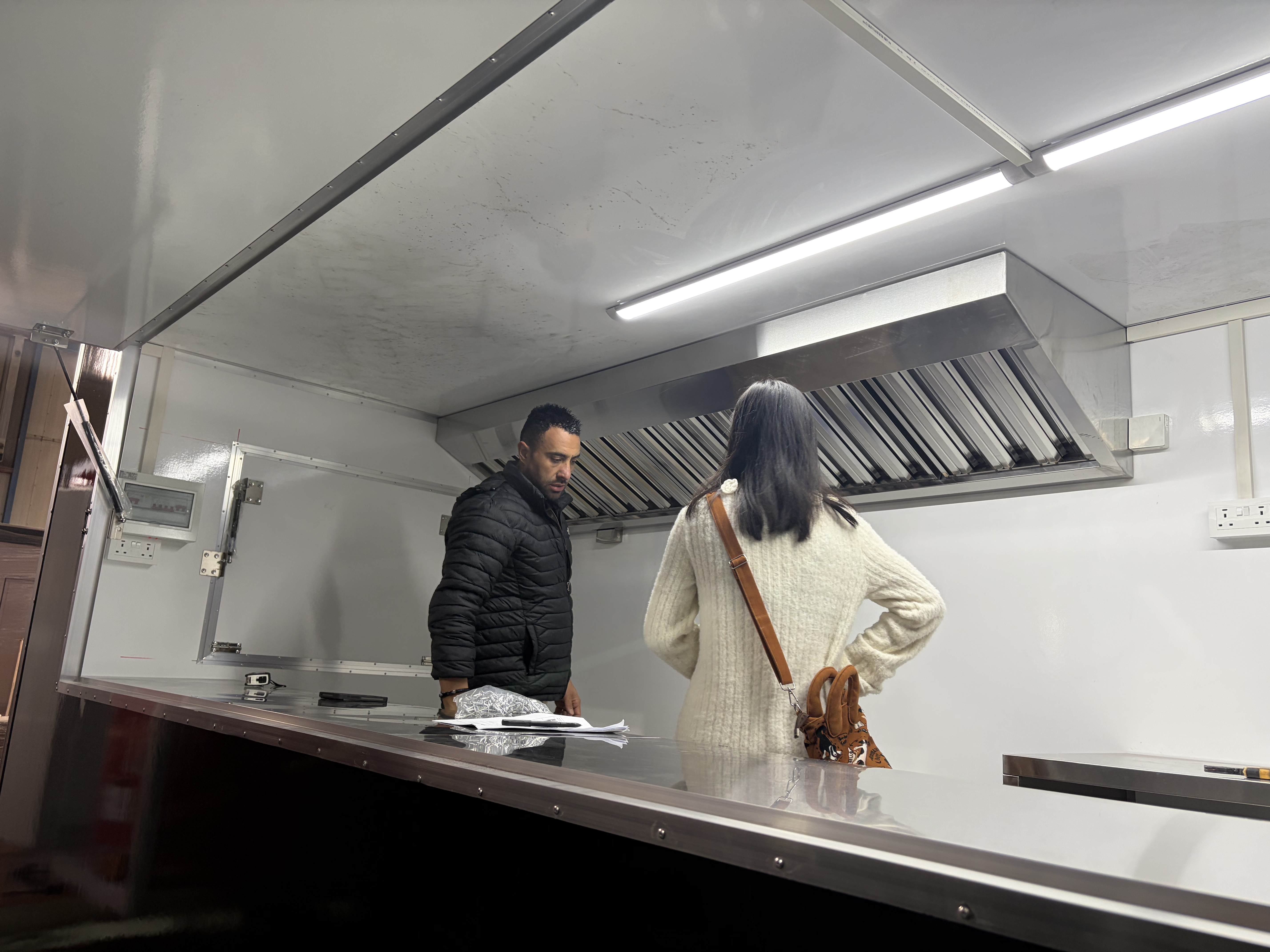
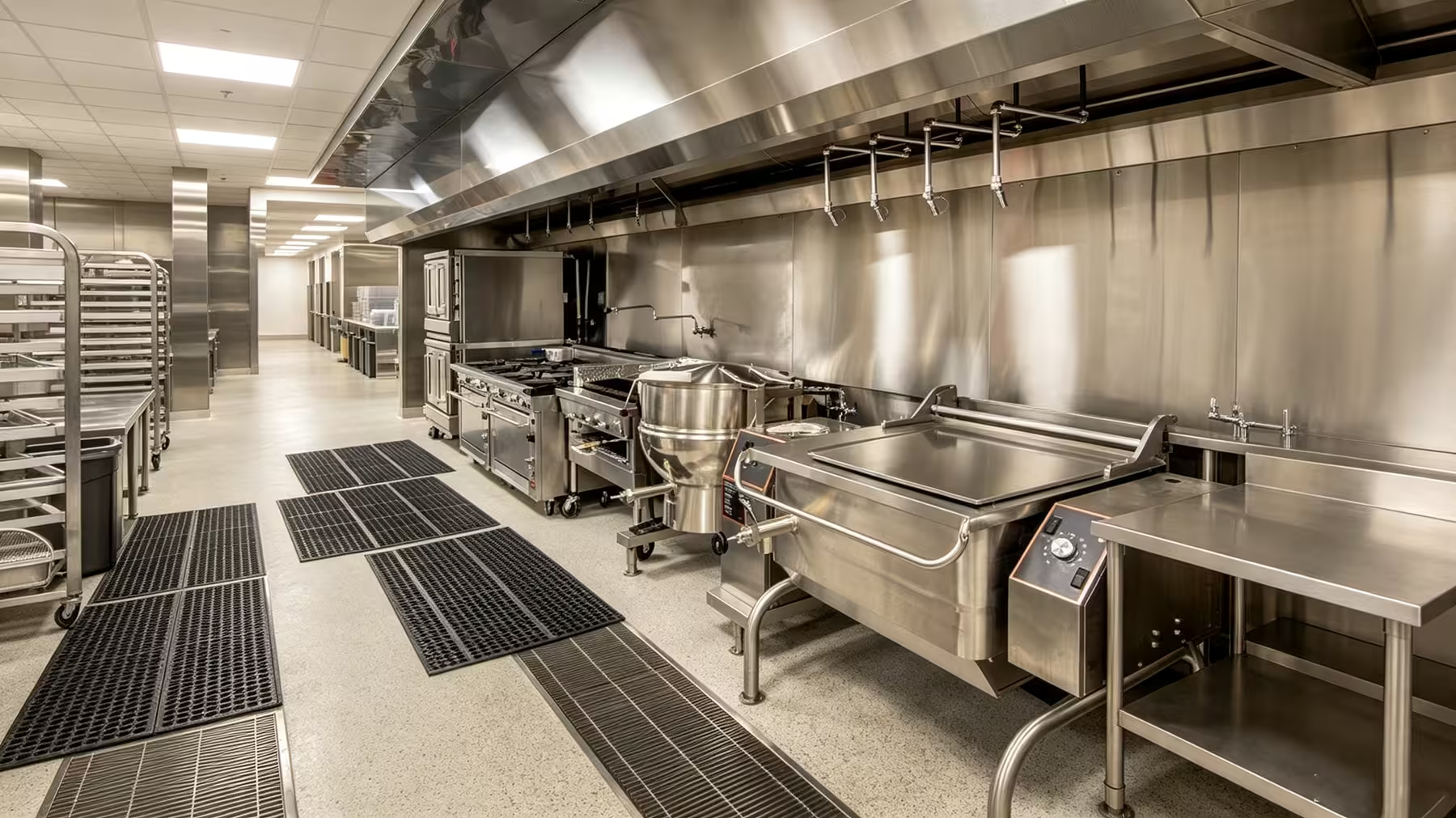
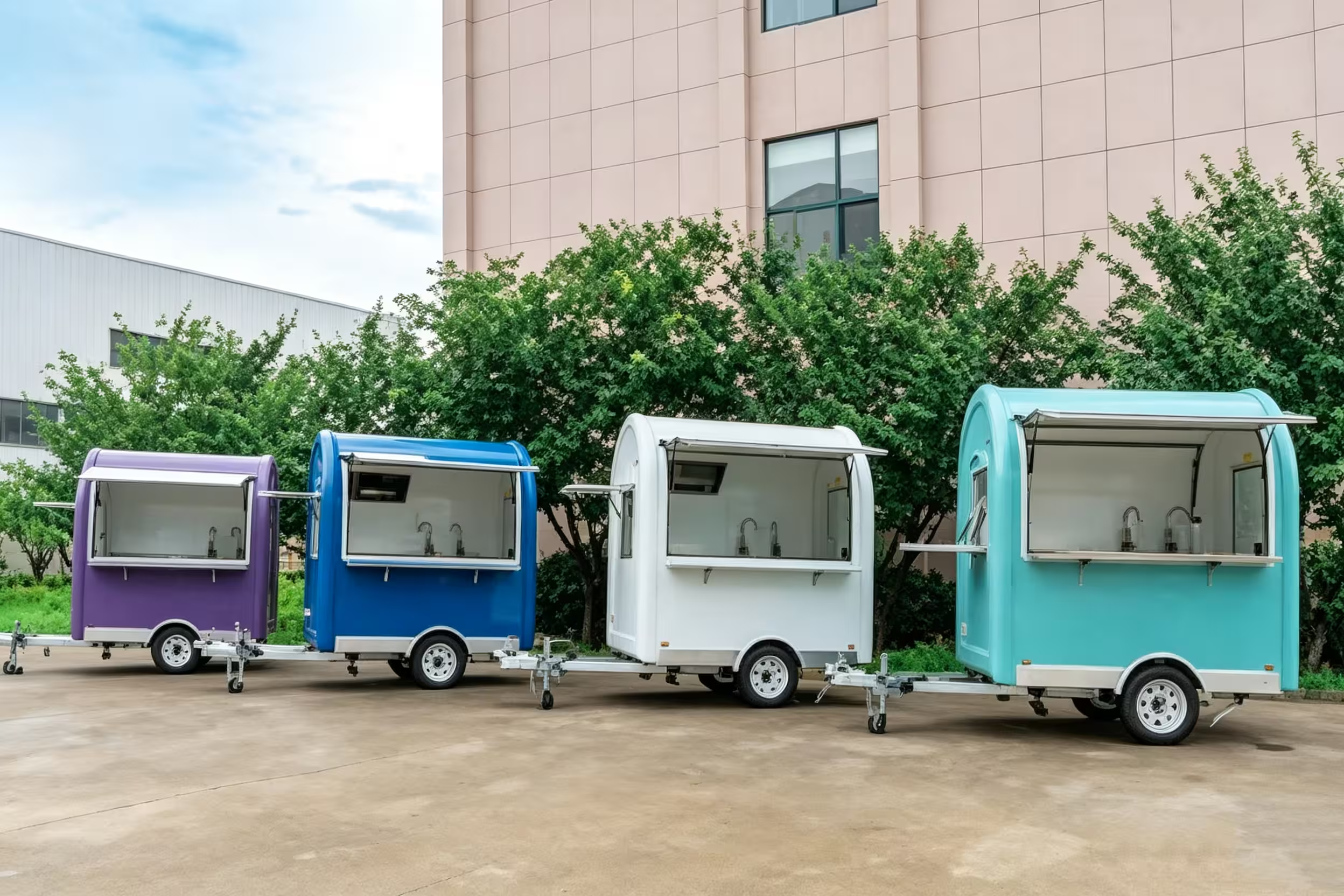
A food trailer is a towable mobile commercial kitchen, and its correct size is determined by the menu, required equipment, number of workers, service volume and local code—not by length alone. As a practical starting point, 10–14 ft trailers suit coffee, drinks, ice cream and limited-prep menus; 14–16 ft trailers suit tacos, sandwiches and compact hot-food kitchens; 16–18 ft trailers suit burgers, fried food, pizza and higher-output cooking; and 18–20+ ft trailers suit BBQ, catering and multi-station kitchens. For many first-time hot-food operators, 16 ft is the most balanced starting point, but it is not a universal answer. Define the menu first, list every appliance and utility load, map staff workflow, confirm local health and fire requirements, then select the shortest trailer that fits the approved layout safely.
| Nominal box length | Best starting use | Typical crew* | Kitchen complexity | Main compromise |
|---|---|---|---|---|
| 10 ft | Coffee, drinks, ice cream, packaged snacks | 1–2 | Light | Very limited storage and hot-line capacity |
| 14 ft | Dessert, tacos, sandwiches, compact burger menu | 2 | Light–medium | Equipment choices must stay disciplined |
| 16 ft | Burgers, fried food, tacos, pizza, Asian food | 2–3 | Medium | Weight and utility demand rise quickly |
| 18 ft | BBQ, pizza, multi-menu, higher-volume service | 3–4 | Medium–heavy | Higher towing, power and parking demands |
| 20 ft+ | Catering, events, multiple workstations, mobile kitchen | 3–5+ | Heavy | Cost, weight, turning radius and site access |
*Crew ranges are workflow planning references, not legal occupancy limits. Exterior width, tongue/porch length, axle placement and interior clear dimensions vary by design.
How to Choose the Right Food Trailer Size
STEP 1Menu
STEP 2Equipment
STEP 3Local review
STEP 4Staff & volume
STEP 5Layout
STEP 6Trailer size
- Lock the menu. Record how every item is received, stored, prepared, cooked, held and served.
- Build the equipment schedule. Include dimensions, weight, fuel, voltage, amperage, heat output and required service clearance for every appliance.
- Check the jurisdiction. The FDA Food Code is a model; states and local authorities adopt and modify it. Ask the actual health, fire, building and vehicle authorities for written checklists.
- Set the operating target. Define crew size, peak orders per hour, storage interval and whether prep happens onboard or in a commissary.
- Draw the workflow. Separate receiving/storage, prep, cooking, plating, service, washing and waste paths as far as the compact space permits.
- Calculate loaded weight and utilities. Include equipment, water, propane, batteries/generator, food, packaging and people.
- Only then choose length. Select the shortest configuration that accommodates the reviewed equipment and a workable aisle without blocking exits or service access.
What Each Trailer Size Can Realistically Do
10 ft Food Trailer: One Focused Service Line
CoffeeBubble teaIce creamDessert
- Typical equipment: espresso machine, grinders, ice maker, undercounter refrigerator, blender station, hand sink and required warewashing setup.
- Planning strength: compact footprint, easier site placement and less unused volume.
- Planning limit: little dry storage; simultaneous cooking, prep and washing can create cross-traffic.
- Best fit: one main product family with 1–2 operators and frequent restocking.
14 ft Food Trailer: Compact but Flexible
TacosSandwichesDessertSimple burgers
- Typical equipment: small griddle, one fryer where approved, compact hood, prep refrigerator, worktable, sinks and upright/undercounter storage.
- Planning strength: can support a tightly controlled cooked-food menu without moving immediately to a large chassis.
- Planning limit: adding “just one more” appliance often removes prep space or blocks service access.
- Best fit: two-person service with a short menu and commissary support.
16 ft Food Trailer: The Common Hot-Kitchen Starting Point
BurgersFried foodPizzaAsian food
- Possible equipment package: 36-inch griddle, fryer battery, prep refrigerator, freezer/refrigerator, hood, sinks, worktop and storage—subject to exact appliance dimensions and local approval.
- Planning strength: often balances cooking capacity, prep space, towing complexity and price for a focused hot-food concept.
- Planning limit: water, refrigeration, hood and generator loads can make weight—not floor area—the controlling factor.
- Best fit: 2–3 operators and one principal cook line.
18 ft Food Trailer: Higher Capacity and Better Separation
BBQPizzaMexicanMulti-menu
- Typical opportunity: a longer hood, larger cold storage, separate prep/holding areas or a porch-mounted system when engineered and approved.
- Planning strength: more room to separate cooking, plating, washing and service tasks.
- Planning limit: larger fresh/waste tanks and equipment can require a higher-capacity axle package and tow vehicle.
- Best fit: 3–4 operators, events or concepts with prep and holding demands.
20 ft+ Food Trailer: A Mobile Commercial Kitchen
CateringHigh-volume eventsMultiple stations
- Typical opportunity: multiple cooking stations, larger refrigeration, more holding equipment and more usable storage.
- Planning strength: capacity and workflow separation.
- Planning limit: higher purchase/shipping cost, greater electrical or generator demand, heavier towing and fewer practical parking sites.
- Best fit: a proven volume need—not simply a desire for the largest trailer.
Recommended Starting Size by Menu
| Food concept | Starting range | Equipment that drives size | Question to resolve first |
|---|---|---|---|
| Coffee / espresso | 10–14 ft | Espresso machine, ice, refrigeration, water treatment | Shore power or generator? Peak drinks/hour? |
| Ice cream / dessert | 10–14 ft | Freezer, dipping cabinet, topping storage | Holding temperature and recovery in hot weather? |
| Bubble tea / beverages | 10–14 ft | Ice maker, sealing machine, refrigeration, water | Daily ice and potable-water demand? |
| Tacos / sandwiches | 14–16 ft | Griddle, hot holding, prep rail, cold storage | Onboard prep or commissary prep? |
| Burgers | 14–18 ft | Griddle, fryers, hood, cold storage | Peak orders and fryer/griddle recovery? |
| Fried chicken | 16–18 ft | Fryers, breading area, hood/suppression, holding | Raw-product separation and oil management? |
| Pizza | 16–20 ft | Oven, dough/prep table, refrigeration, ventilation | Oven type, fuel and required clearances? |
| BBQ | 16–20+ ft | Smoker, hood, hot holding, prep and bulk storage | Is the smoker onboard, porch-mounted or off-unit? |
| Multi-menu / catering | 18–20+ ft | Multiple cook stations, refrigeration and holding | Can the menu be simplified at peak service? |
These are general planning ranges, not fixed requirements. Actual size depends on exact appliances, approved food process, local rules, loaded weight and expected output.
Layout Specifications to Confirm Before Ordering
| Item | What to document | Why it changes size |
|---|---|---|
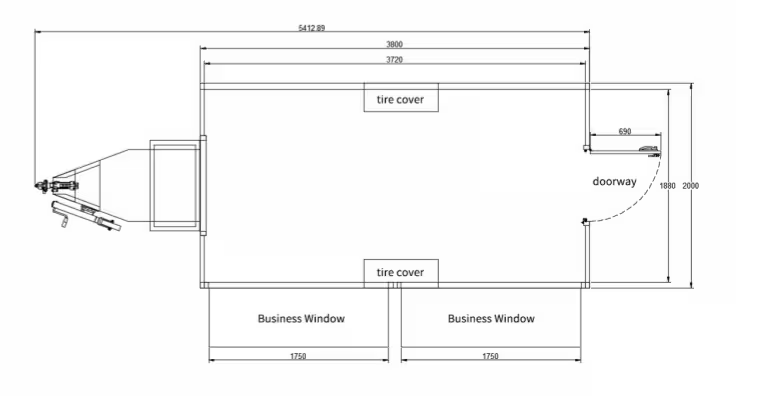
| Interior clear dimensions | Finished wall-to-wall, floor-to-ceiling and wheel-box intrusions | Nominal exterior length is not usable kitchen length. |
| Aisle and doors | Clear aisle at pinch points; door swing; unobstructed exit path | Appliance handles and doors consume working clearance. Confirm with the AHJ. |
| Cooking line | Appliance width/depth, listed clearances, hood capture area and suppression | Grease-producing appliances commonly trigger ventilation and fire-protection requirements. |
| Warewashing | Required compartments, drainboards, utensil size and water-heater recovery | Sinks and drainboards consume significant counter length. |
| Handwashing | Dedicated sink location, hot water, soap, drying and access | The FDA model Food Code requires conveniently located handwashing facilities; local adoption controls. |
| Water system | Fresh/waste capacities, pump, heater, fill and drain locations | Water is heavy: 1 US gallon weighs about 8.34 lb (3.78 kg). |
| Electrical | Voltage, running amps, startup loads, panel, shore inlet and generator | Peak demand determines panel/generator size, ventilation and equipment choices. |
| LP gas | Appliance input, tank location, regulator, piping, shutoff and leak test plan | Fuel storage and clearances affect chassis and exterior layout. |
| Cold/dry storage | Days between restocking and actual food/packaging volume | Storage, not cooking, often forces the next length up. |
| Service windows | Window location, counter, POS, pickup and customer flow | Service placement must not conflict with cooking or egress. |
Weight and Towing Can Set the Limit Before Floor Space Does
Do not select the tow vehicle from the empty trailer weight. Ask for the completed trailer’s ratings and a realistic loaded-weight calculation.
- GVWR: maximum permitted loaded vehicle weight specified by the manufacturer.
- GAWR: maximum permitted load on each axle system.
- Payload: capacity remaining for equipment, water, fuel, food, supplies and modifications after accounting for the trailer’s actual empty/curb weight.
- Tongue weight: must stay within the hitch, tow vehicle and trailer manufacturer limits; final loading must preserve stable weight distribution.
- Tow rating: use the vehicle maker’s specific configuration data, including hitch, axle ratio, passengers and cargo.
Illustrative water-weight check: 30 US gal fresh water + 40 US gal wastewater capacity represents up to about 584 lb (265 kg) of water when both are considered at full capacity. Do not assume both tanks will always be full simultaneously; do include the worst credible operating/loading condition in engineering review.
Three Layout Examples—Use as Briefs, Not Approved Plans
| Example | Cooking side | Opposite side | Critical review |
|---|---|---|---|
| 14 ft compact burger | Griddle → fryer → landing area under approved hood | Prep refrigerator → sinks → POS/service | Raw/cooked separation, hood limits, fryer clearance, drainboards |
| 16 ft pizza | Listed oven → landing/holding → service | Dough/prep table → refrigeration → sinks/storage | Oven fuel, heat rejection, clearances, dough workflow |
| 18 ft BBQ | Approved smoker/porch arrangement → hot holding → plating | Cold prep → refrigeration → sinks → service | Solid-fuel/grease fire protection, smoke, porch weight, hot holding |
Information Gain: What Real Evidence to Add
The strongest version of this guide should contain verifiable NewBeacon evidence, not generic stock photography. Before publishing, add at least two of the following modules:
- ✓ One factory photo series showing tape-measured interior dimensions for two trailer sizes.
- ✓ A verified weighbridge ticket matched to a finished equipment schedule.
- ✓ A dated production-floor comparison showing what extra equipment fits when moving from 14 ft to 16 ft.
- ✓ A customer case study with written permission, location, menu, final size, team size and a direct customer statement.
- ✓ An inspector-requested design revision, anonymized where necessary, with before/after plans and the exact lesson learned.
Food Trailer Size FAQ
What is the most common food trailer size?
There is no authoritative national “most common” size dataset. In practical planning, 14–18 ft covers many focused cooked-food concepts, and 16 ft is often a useful first layout to test. Choose from the equipment plan and loaded-weight calculation, not popularity.
Is a 10 ft food trailer big enough?
Yes for a disciplined beverage, frozen-dessert or low-complexity menu. It is usually too constrained for several hot appliances, bulk storage and multiple simultaneous work zones.
Is a 16 ft food trailer big enough for burgers and fries?
Often, yes, if the menu and appliance package are focused. Confirm the griddle/fryer capacity, hood and suppression design, cold storage, sinks, water, electrical/LP loads, aisle and loaded weight before ordering.
What size food trailer is best for BBQ?
Start testing layouts at 16–20+ ft. Smoker position, solid-fuel rules, hot holding, bulk meat storage, ventilation and porch/chassis loading usually control the answer.
Does trailer length include the tongue or porch?
Not always. Sellers may describe box length, overall body length or overall trailer length differently. Require a dimensioned drawing showing box, tongue, porch, bumper, width, height and interior clear dimensions.
How wide is a food trailer?
Exterior bodies are commonly designed within road-legal dimensional limits, but exact maximum width and permit rules depend on jurisdiction. Interior width is reduced by wall construction and equipment depth. Confirm the finished dimensions and transport route.
Should I buy a larger trailer for future growth?
Only when the future equipment, staffing and sales plan is credible. Unused length adds cost, weight, towing demand and parking difficulty. A focused menu and faster workflow can outperform a larger but poorly planned kitchen.
Can NewBeacon guarantee local health or fire approval?
No manufacturer can honestly guarantee approval in every jurisdiction. NewBeacon can design around the written requirements you provide and prepare technical information, but the local AHJ makes the final decision.
Still Not Sure What Size You Need?
Send NewBeacon your menu, target city, equipment wish list, expected crew, peak orders and local health/fire checklist. We can use them to prepare a preliminary equipment plan and layout before production.
Get My Preliminary LayoutExplore NewBeacon TrailersSources and Important Note
This article uses public safety and regulatory sources plus general design-planning ranges. The FDA Food Code is a model, not a single nationwide permit rule. Standards, adopted editions, fees and interpretations can change. Always obtain current written requirements from the health, fire, vehicle, building and zoning authorities that will review your specific trailer.
- U.S. FDA, 2022 Food Code — model retail-food safety provisions and mobile food establishment matrix.
- U.S. FDA, State Retail and Food Service Codes and Regulations by State — starting point for adopted state rules.
- National Fire Protection Association, Food Truck Safety Fact Sheet — mobile cooking fire-safety checklist referencing NFPA 1, 58 and 96.
- NHTSA, Towing a Trailer: Being Equipped for Safety — towing terms, loading and safety guidance.
- OSHA, Food Services: Slips, Trips and Falls — keeping walking-working surfaces and passageways clear.
 Custom Food Trailers & Complete Mobile Kitchen Solutions